

If you are already receiving payments under the VEA or DRCA, most existing payments and entitlements will continue unchanged. However, the reforms may become important if your circumstances change, including worsening conditions, new claims, reassessments, or conditions that previously did not qualify for compensation.
There are many possible scenarios, and DVA has provided examples of how the VETS Act will affect Veterans under previous schemes who choose to make new claims or reassess old ones. I’ll discuss these throughout this article and provide our own commentary.
What is the VETS Act 2025?
Historically, veteran compensation and support in Australia have operated through multiple legislative systems depending on when and how a person served. These included the VEA, DRCA, and MRCA, each with different rules, eligibility requirements, and assessment methods.
As a result, veterans with similar service-related conditions could receive different outcomes depending on which legislation applied to them. This has created confusion around claims, compensation, and ongoing support.
The VETS Act 2025 was introduced to simplify these systems. From 1 July 2026, new compensation claims will transition to an updated MRCA framework designed to create greater consistency in how claims, impairment, and entitlements are assessed over time.
What Is Actually Changing Under the VETS Act?
The reforms are designed to simplify the system and create greater consistency in how service-related conditions are recognised and supported.
Changes include:
- A single claims pathway for new compensation claims
- Updated impairment assessment methods
- Changes to rehabilitation and treatment access
- Different approaches to compensation payments, including SRDP eligibility
- Improved consideration of multiple accepted conditions when assessing impairment and compensation
VEA and DRCA are closing to new claims
Under the VETS Act, new compensation and rehabilitation claims will be assessed under the improved Military Rehabilitation and Compensation Act (MRCA).
This does not mean VEA or DRCA will disappear entirely. Existing claims and accepted conditions remain recognised, while current entitlements continue under grandfathering arrangements.
Example: Barney may receive significantly higher compensation for a new accepted condition
Barney is 44 and has service covered under the VEA, DRCA and MRCA, with accepted service-related conditions across all three Acts. He currently receives a 20% Disability Compensation Payment (DCP) under the VEA and has previously received $26,000 in MRCA Permanent Impairment (PI) compensation. His DRCA condition is below the payable threshold, and he continues to work. Barney now wants to claim a mental health condition related to his earlier VEA service.
Under DVA’s example, Barney’s current 20% DCP payment of $126.22 per fortnight continues unchanged under grandfathering arrangements. However, his new mental health condition would be assessed under MRCA rather than the VEA.
Because the MRCA assessment considers the combined impact of previously accepted conditions and the new impairment, Barney’s overall impairment assessment increases from 10 points to 61 points. As a result, he becomes eligible for additional Permanent Impairment compensation of $362.90 per fortnight or, alternatively, an age-based lump sum payment of $211,952.32. Barney is also issued a Gold Card.
Result: Barney continues receiving his existing DCP payment while gaining access to significantly higher compensation options for his new accepted condition, even though the condition relates to earlier VEA service.
Claims pathways will become more consistent
The VETS Act will also increase the use of Statements of Principles (SoPs) when assessing claims. Statements of Principles are medical and scientific guidelines used to determine whether a condition can be linked to military service. They outline the factors that must be present for a condition to be accepted as service-related.
Greater reliance on SoPs may make claims easier to assess where recognised medical links to service already exist. In some circumstances, this may reduce the amount of supporting evidence required and create a clearer pathway through the claims process.
Some DRCA Incapacity Payments May Increase
The VETS Act also affects veterans currently receiving incapacity payments under the DRCA. In some circumstances, existing DRCA incapacity payments may automatically transition to MRCA incapacity rates.
Because incapacity payments are calculated differently under the MRCA, some veterans may receive higher fortnightly payments without having to lodge a new claim. However, outcomes will vary depending on service history, compensation arrangements, and individual circumstances.
Example: David’s incapacity payments increase even though his circumstances have not changed
David is 56 and receives DRCA incapacity payments, along with a Commonwealth-funded superannuation payment. Under DVA’s example, his gross fortnightly incapacity payment increases from $1,394.18 under DRCA to $2,231.08 under MRCA.
This happens because MRCA incapacity payments are calculated differently. The MRCA calculation may use the current pay rate for the veteran’s eligible rank and pay level, does not apply the same additional 5% reduction for notional superannuation contributions, and includes a remuneration loading for the loss of non-salary benefits from ADF service.
Result: David receives a higher fortnightly payment, even though his health, work capacity and broader circumstances have not changed.
Permanent Impairment assessments will work differently
One of the most important technical changes under the VETS Act is how Permanent Impairment (PI) may be assessed.
Under the current DRCA framework, accepted service-related conditions are often assessed separately when determining impairment and compensation. This means each condition generally needs to meet a minimum impairment threshold on its own before compensation becomes payable.
Under the new framework, impairment assessments work differently. Rather than assessing conditions in isolation, accepted service-related conditions may be combined using a whole-of-body assessment.
This means multiple accepted conditions, such as hearing loss, tinnitus, musculoskeletal injuries, or mental health conditions, may be assessed together to determine an overall impairment rating.
To calculate this, MRCA uses a Combined Values Chart, which determines the combined impact of multiple accepted conditions on a veteran’s overall level of impairment.
This may provide access to Permanent Impairment compensation where it was previously not payable because individual conditions fell below compensation thresholds. In some circumstances, higher impairment ratings may also influence eligibility for benefits such as the Veteran Gold Card.
How Whole-of-Body Assessments Could Affect Compensation
The shift to whole-of-body Permanent Impairment assessments may create different outcomes depending on your circumstances.
For some, combining multiple accepted conditions may result in eligibility for compensation where no payment was previously available. For others, particularly veterans who have already received substantial Permanent Impairment compensation under DRCA, reassessment may not automatically lead to additional payments.
The examples below demonstrate how the same reforms may create different outcomes.
Example: Mary may become eligible for compensation where none was previously payable
Mary is 55 and has service covered only under DRCA. She has accepted service-related conditions for her ankle and tinnitus, but has not previously received Permanent Impairment (PI) compensation because each condition, when assessed individually, fell below the required DRCA payment threshold.
Under DVA’s example, Mary would not receive any PI payment under the current DRCA system because her ankle and tinnitus are assessed separately, and neither condition meets the minimum threshold for compensation on its own.
Under the new arrangements, Mary’s accepted conditions are assessed differently. Under MRCA, Mary’s accepted conditions are assessed together, increasing her overall impairment rating to 19 points and exceeding the payable threshold. This results in a new impairment assessment of 19 points, which exceeds the minimum payable threshold.
Result: Mary becomes eligible for Permanent Impairment compensation of $96.42 per fortnight or, alternatively, an age-based lump sum payment of $49,608.09 even though her individual conditions did not previously qualify for payment under DRCA.

Example: Roger may receive no additional compensation despite a new accepted impairment
Roger is 44 and has previously received multiple Permanent Impairment (PI) payments under DRCA totalling approximately $377,000. He lodges a new PI claim for an ankle injury that has already been accepted as service-related under DRCA.
Under the current DRCA system, Roger’s ankle injury is assessed separately and results in a 10% impairment rating. This would entitle him to an additional lump sum PI payment of $34,317.52.
Under DVA’s example of the new arrangements, Roger’s previously compensated conditions are assessed together using the MRCA whole-of-person impairment model. His prior accepted conditions equate to 66 impairment points, and the new ankle assessment increases his overall impairment to 70 points.
Because Roger’s reassessment does not result in a minimum 5-point increase in impairment, no additional Permanent Impairment compensation is payable. Roger also does not qualify for a Gold Card because he does not meet the MRCA threshold requirements.
Result: Roger receives no additional PI compensation for his new ankle assessment, even though he may have been eligible for a lump sum payment under the current DRCA system.
Some veterans may have broader access to PI compensation
The VETS Act provides access to Permanent Impairment (PI) compensation to some veterans for whom it was previously unavailable.
This is especially relevant for veterans who have accepted service-related conditions but have not previously received PI compensation because those conditions did not meet the required threshold on their own.
This may include veterans with accepted but non-payable conditions such as hearing loss, tinnitus, musculoskeletal injuries or mental health conditions. Under the updated MRCA framework, these conditions may be considered as part of an overall impairment assessment, rather than being viewed only in isolation.
The changes may also be relevant for veterans with National Service, older Act coverage or DRCA-only service, where compensation pathways were previously more limited. For some veterans, the new framework may create an opportunity to have accepted conditions reassessed and potentially receive compensation that was previously unavailable.
Where a veteran qualifies for Permanent Impairment compensation, they may also be offered a choice between ongoing fortnightly PI payments and an age-based lump sum. This choice can have long-term financial consequences, so it is important to understand how each option may affect your income, tax position, superannuation, retirement planning and broader financial security.
The examples below demonstrate how these changes may create different compensation outcomes.
Example: Paul may become eligible for compensation that was previously unavailable
Paul is 74 and has reserve service covered under the 1971 Act, which predates the current DRCA system. He has previously lodged claims relating to knee and back conditions but did not receive Permanent Impairment (PI) compensation. Paul has now lodged a liability claim for PTSD, which he has experienced since the early 1980s.
Under the current arrangements, Paul’s mental health condition may be accepted as service-related under the 1971 Act. However, the legislation does not provide access to Permanent Impairment compensation for these conditions, meaning no PI payment would be payable.
Under DVA’s example of the new arrangements, Paul’s PTSD claim is assessed under MRCA rules. Because Paul has not previously received compensation payments, his prior impairment assessment starts at 0 points. Following assessment, his overall impairment is assessed at 72 points, with a lifestyle rating of 6.
As a result, Paul becomes eligible for Permanent Impairment compensation of $663.58 per fortnight or an age-based lump sum payment of $174,422. He also qualifies for the new Additional Disablement Amount (ADA), worth $269.62 per fortnight, and receives a Gold Card.
Result: Paul gains access to compensation and ongoing support that was not available to him under the older 1971 Act, despite living with his condition for decades.

Example: Lyle may gain access to compensation for previously unrecognised impairments
Lyle is 78 and completed National Service between 1967 and 1969. He has previously received Permanent Impairment (PI) compensation under DRCA for bilateral shoulder conditions, but was unsuccessful in a prior claim for hearing loss. Lyle has now lodged a claim for a service-related back condition.
Under the current DRCA system, Lyle’s back condition is assessed separately and accepted as service-related. Based on this assessment, he would receive a DRCA Permanent Impairment lump sum payment of $75,092.88.
Under DVA’s example of the new arrangements, Lyle’s back condition is assessed under MRCA rules, and he requests a whole-of-person Permanent Impairment assessment. His previous shoulder compensation contributes 10 impairment points, and the new assessment results in a total impairment rating of 63 points with a lifestyle rating of 5.
Importantly, this assessment considers more than just the new back condition. It also includes worsening of Lyle’s previously compensated shoulder conditions and recognises his service-related hearing loss, which had not previously qualified for compensation.
As a result, Lyle becomes eligible for Permanent Impairment compensation of $443.19 per fortnight or an age-based lump sum payment of $95,418.88. He also qualifies for a Gold Card.
Result: Lyle may receive compensation that reflects the combined impact of multiple service-related conditions, including worsening injuries and previously uncompensated hearing loss.
More Veterans May Now Be Eligible for SRDP
The VETS Act changes may also expand access to the Special Rate Disability Pension (SRDP). Under the current system, DRCA veterans do not generally have access to SRDP. Under the improved framework, veterans who transition into the MRCA system may now become eligible for assessment.
The changes also remove the “alone test” previously associated with Veterans’ Entitlements Act 1986 TPI assessments. Under the previous approach, veterans needed to show that their service-related conditions alone prevented them from working, without other non-service-related conditions or circumstances contributing to their inability to work. Under the new framework, eligibility will focus more heavily on overall impairment levels and capacity to work.
Importantly, SRDP is not automatically applied. Veterans who may be eligible need to request an assessment, and eligibility will depend on meeting the relevant impairment and incapacity thresholds.
Worsening conditions will be handled differently
Under the VEA system, veterans receiving Disability Compensation Payments (DCP) can apply for an increase if accepted conditions worsen over time. From 1 July 2026, rather than applying for an increase to DCP, worsening conditions will be assessed through the MRCA Permanent Impairment framework.
Worsening conditions may result in:
- Additional Permanent Impairment compensation
- Access to new payment structures, including age-based lump sum options
- Eligibility for benefits such as the Additional Disablement Amount (ADA) or a Veteran Gold Card, depending on circumstances
Example: Matthew may access new compensation options when his conditions worsen
Matthew is 68 and currently receives a 50% Disability Compensation Payment (DCP) for accepted service-related conditions under the VEA. As Matthew has aged, his conditions have worsened, and he lodges a claim to have all conditions reassessed.
Under the current VEA system, Matthew’s worsening conditions increase his impairment to 70 points with a lifestyle rating of 6. This makes him eligible for the Extreme Disablement Adjustment (EDA) rate, increasing his fortnightly compensation from $304.00 to $933.20 and providing access to a Gold Card.
Under DVA’s example of the new arrangements, Matthew’s existing 50% DCP payment of $304.00 per fortnight remains unchanged under grandfathering. However, instead of applying for an increase to DCP, his worsening conditions are assessed under the MRCA Permanent Impairment rules.
Matthew’s previous compensation contributes 30 impairment points, and his reassessment results in a total impairment rating of 70 points with a lifestyle rating of 6. As a result, he becomes eligible for Permanent Impairment compensation of $444.82 per fortnight or an age-based lump sum payment of $149,056.09. He also qualifies for the Additional Disablement Amount (ADA) of $184.38 per fortnight and continues to receive a Gold Card.
Result: Matthew continues receiving his existing VEA payment while gaining access to additional compensation for worsening conditions through MRCA assessment pathways.

A New ADA Benefit
The VETS Act also introduces a new payment called the Additional Disablement Amount (ADA). The ADA is designed to provide additional support to severely disabled and aging veterans and is intended to replace benefits such as the Extreme Disablement Adjustment (EDA) currently available under the Veterans’ Entitlements Act 1986 (VEA).
Eligibility for the ADA will generally depend on factors such as:
- impairment levels
- lifestyle ratings
- age-related eligibility requirements
- existing compensation arrangements
However, the ADA is also subject to offset arrangements. The payment may be reduced depending on:
- other compensation payments already being received
- existing permanent impairment compensation
- Commonwealth-funded superannuation payments
This means two veterans with similar impairment levels may receive different ADA outcomes depending on their existing compensation and superannuation arrangements. For this reason, understanding how ADA interacts with other payments is important before making decisions about compensation or reassessment under the new framework.
Treatment, Rehabilitation and Household Services
Under the new framework, access to broader rehabilitation programs and household services may become available. This may include support design to help veterans maintain independence and manage the impact of service-related conditions with a stronger focus on early intervention.
Non-Liability Health Care (NLHC) will also be moved from the VEA into the MRCA. This means eligible veterans can continue to access treatment for specified conditions without needing to establish a link to service. However, this is a transfer of the existing NLHC framework, not an expansion of eligibility. The Explanatory Memorandum states that NLHC will move to the MRCA with no change in eligibility requirements.
What Happens to Existing Payments or Benefits?
For veterans currently receiving compensation or support, existing payments and entitlements will continue under grandfathering arrangements. This means the VETS Act does not remove current benefits, and if your circumstances remain unchanged, there may be little or no practical difference to the support you currently receive.
This includes ongoing compensation payments, pensions, and other existing entitlements, which will continue to be indexed in line with current arrangements.
If your circumstances change, future reassessment opportunities may arise where conditions worsen, multiple accepted conditions exist, or previous claims were accepted but did not meet compensation thresholds.
Example: Charlie’s existing payments continue unchanged if his circumstances stay the same
Charlie is 69 and currently receives a Special Rate Disability Compensation Payment (commonly known as TPI), a Service Pension, and holds a Gold Card. His circumstances are stable, and he wants to understand whether the VETS Act reforms will affect his current payments and support.
Under DVA’s example, Charlie’s Special Rate DCP payment of $1,729.20 per fortnight continues unchanged under grandfathering arrangements. His Service Pension also remains unaffected, and he continues to retain access to his Gold Card.
Because Charlie’s circumstances have not changed and he is not lodging a new compensation or rehabilitation claim, there is no immediate impact from the new legislation.
However, Charlie may gain access to additional rehabilitation supports available under MRCA, such as household services related to his accepted service-related conditions. DVA also notes that automatic War Widow’s Pension eligibility for Charlie’s partner remains unchanged under the VEA. If Charlie’s passing were related to service, his partner may also have the option to lodge a compensation claim under MRCA.
Result: Charlie’s existing payments, pension, and Gold Card remain unchanged because his circumstances are stable and no new claims are being made.
What About Claims in Progress?
If you already have a claim lodged before 1 July 2026, it will generally continue to be assessed under the legislation that applied when the claim was made. The introduction of the VETS Act does not cancel existing claims or remove current entitlements.
Veterans currently receiving Disability Compensation Payments (DCP) under the VEA will continue to receive those payments. However, the traditional Application for Increase process will no longer apply to worsening conditions under the new framework. Instead, worsening accepted conditions may be assessed through the MRCA Permanent Impairment processes.
Do you need to do anything before 1 July 2026?
If your circumstances are stable and you are not lodging a new claim, your existing payments and entitlements may continue largely unchanged.
However, the changes may be important if your service-related conditions have worsened, you have accepted conditions that were previously not payable, or you are considering a new claim before the new framework begins. It may also be worth reviewing which Act your current entitlements sit under – VEA, DRCA or MRCA – and which conditions DVA has already accepted as service-related.
For some veterans, timing may matter. A claim lodged before 1 July 2026 may be assessed differently to a claim lodged after the transition begins. In other cases, waiting until the MRCA framework applies may create different assessment or compensation options. The right approach will depend on your service history, accepted conditions, current payments and broader financial position.
SRDP and Permanent Impairment decisions also need careful consideration. If you are offered SRDP or a PI lump sum election, the decision may affect your long-term income, tax position, superannuation, retirement planning and household financial security. These are not decisions to rush or make in isolation.
Before lodging a new claim, requesting a reassessment, or accepting a major compensation offer, consider getting financial advice about how the changes may apply to your circumstances. Not every veteran will need to act before 1 July 2026, but some may benefit from reviewing their position before the new system begins.
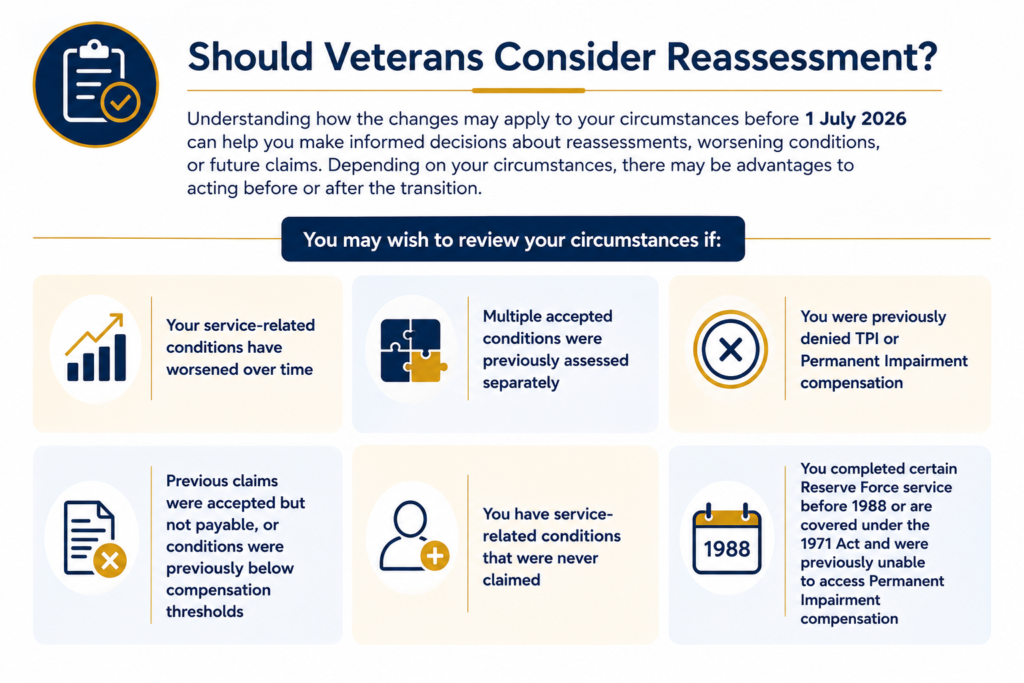
Should You Consider Reassessment?
Understanding how the changes may apply to your circumstances before 1 July 2026 can help you make informed decisions about reassessments, worsening conditions, or future claims. Depending on your circumstances, there may be advantages to acting before or after the transition.
You may wish to review your circumstances if:
- Your service-related conditions have worsened over time
- Multiple accepted conditions were previously assessed separately
- You were previously denied TPI or Permanent Impairment compensation
- Previous claims were accepted but not payable, or conditions were previously below compensation thresholds
- You have service-related conditions that were never claimed
- You completed certain Reserve Force service before 1988 or are covered under the 1971 Act, and were previously unable to access Permanent Impairment compensation
Before making a compensation decision, consider financial advice
The VETS Act represents one of the biggest changes to veteran compensation and rehabilitation in decades. While many existing payments and entitlements will remain unchanged, the reforms may affect how future claims are assessed, how worsening conditions are reviewed, and which compensation pathways become available.
Because outcomes may differ depending on service history, accepted conditions, and previous compensation arrangements, understanding how the reforms apply to your circumstances can help you make more informed decisions.
If you’re offered SRDP, you’re required to seek financial advice before making a decision. DVA reimburses eligible financial advice costs up to a set statutory amount.
National Service Financial is a veteran-owned practice led by Wayne Bemet, who served 20 years in the Royal Australian Navy before his own medical discharge. We help veterans become more financially educated. Having experienced the DVA system personally and professionally, Wayne understands the complexities veterans and their families can face.
If you are unsure how the VETS Act changes may apply to your circumstances, explore our DVA financial advice services to better understand your options and what steps may be available to you.